All bad actors are alike; each great actor is great in his own way.
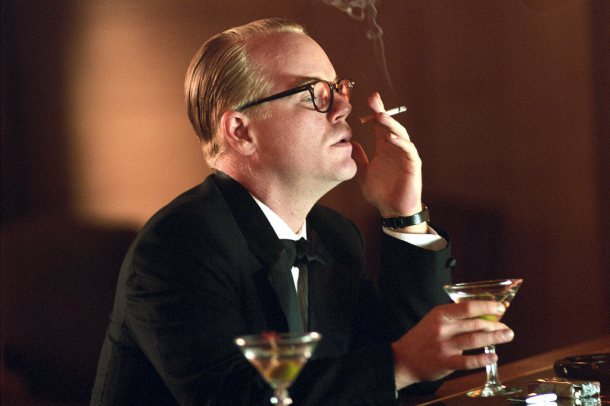
Charlie Chaplin was always the Tramp, our childish hero, even while playing Hitler. Humphrey Bogart was by turns fearsome and rumpled, the man we all wanted to be while looking like the man we all feared we were. Cary Grant combined the grace of Fred Astaire, the slapstick of Harold Lloyd, and the class of James Stewart while never investing in a role he played. Marlon Brando did nothing but invest in his roles, taking on the pain, pleasure, and sorrow of each character while never letting us forget that he was Marlon Brando.
Yesterday we lost another great actor, great in his own way. Philip Seymour Hoffman, 46, took on the persona of his characters like few other actors before him. He wasn’t a chameleon, making us forget who we were watching. Yet he embodied each role, never letting the audience draw a connection between his current performance and his past performances because his current performance was the only one that ever mattered. Playing each character with aplomb and brio gave Hoffman a range few actors have even attempted.
In a span of five years, Hoffman played thirteen roles, six of which highlight his ability to effect a complete transformation into almost any kind of role. Hoffman played the villain in Twister (1996), the shy, gay, boom operator in Boogie Nights (1997), the creepy suburban masturbator in Happiness (1998), the gentle nurse in Magnolia (1999), the brash, misogynistic Princeton grad in The Talented Mr. Ripley (1999), and the nervous, sensitive playwright in State and Main (2000). These transformations were not physical but emotional. They leave us wondering how one man could so clearly be so many men.[1]
Those five years do not include any of this Oscar nominated roles, which only came after another five years of playing small roles of great range.[2] When he was finally recognized by the Academy, it was for Capote (2006). Though Toby Jones looked and sounded more like Capote in Infamous (2006), Hoffman was not just mimicking the author, he became Capote. Two years later he received Golden Globe nominations for playing a sad-sack Bertolt Brecht scholar in The Savages (2007) and a maverick CIA agent in Charlie Wilson’s War (2007). The density and diversity of his work continued until yesterday, when Hoffman was found dead of an apparent heroin overdose in his Greenwich Village apartment.
Despite the accolades and awards that came in the years after Capote, my favorite Hoffman roles tend to be the supporting ones. As a supporting actor you have limited time to convey the complex humanity of your character; to show that your character is not a caricature. Hoffman could often do this in a single short scene or even line. He could do it any number of ways. Here, in Punch-Drunk Love, on the phone with Adam Sandler, you get to know the Mattress Man, the man, immediately (this clip has some NSFW words):
In The Talented Mr. Ripley it comes when he pulls up in his Fiat convertible, jumps out, walks past some Italian beauties, and asks, rhetorically, “Don’t you want to fuck every woman you see just once?”
In Magnolia, it comes when he calls a grocery store to place an order for peanut butter, jelly, bread, cigarettes, and, hesitantly, some porno magazines. Having heard the request for the magazines, the person taking the order naturally asks, “Um, do you still want the sandwich stuff.” Hoffman’s response is a befuddled, “Yes.” He called to order food, the magazines are ancillary. Why would anyone think it would be the reverse?
Despite my affinity for his supporting roles, Hoffman’s best performance, in my mind, is as the theater director Caden Cotard in Synecdoche, New York. A true Charlie Kaufman film, Synecdoche, New York is a sprawling, messy film about making art and living life. Or maybe it is an epic, intricate film about making life and living art. In the movie that Roger Ebert named the best of the decade, there is no single moment, no single scene that stands out to encapsulate Cotard. That is because the film is about a life, that life is Cotard’s but, as Ebert wrote, “[Cotard] could be me. He could be you. The job, the name, the race, the gender, the environment, all change. The human remains pretty much the same.”
That is not to say that Hoffman played everyman (though he did play Willy Loman on stage in 2012). Rather Hoffman excelled at playing any man. His range and frequencies of roles meant that he relished playing almost any type of character. But Hoffman’s greatest role was not playing a man but living the life of a man. As his Cotard says, “There are millions of people in the world. None of those people is an extra. They’re all the leads of their own stories. They have to be given their due.”
Hoffman has left us the gift of every second of film he was captured on, and among those I will remember him best in his supporting work. But Philip Seymour Hoffman was not an extra in any of our lives. He was the lead in his own story. And yesterday we learned that story ends in tragedy.
[1] Coincidentally, last week I watched the first thing Hoffman ever appeared in – an first season episode of Law & Order (streaming on Netflix). It is a bit role, but his accused rapist character is half threatening, half scared. And like all his other roles, it is nothing like his other roles.
[2] These include but are not limited to: the rock journalist in Almost Famous (2000), the scheming mattress salesman in Punch-Drunk Love (2002), and the corrupt preacher in Cold Mountain (2003).
[featured image from Flickr user cTm Designs]

Reblogged this on Imarashed.