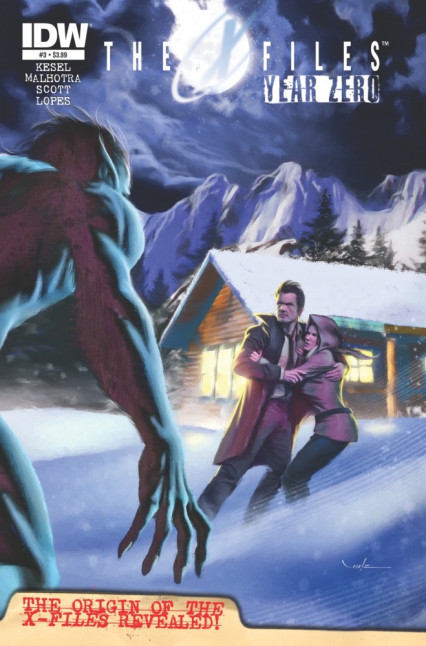
by Anna Josephson and Jeff Michler
ANNA: All right, Jeff – we’re back and talking about The X-Files again! After the delay Year Zero has returned with #3. What did you think of this issue?
JEFF: We are. And while you probably can’t hear it, I am playing the spooky return from commercial break X-Files music in my head.
A: Oh rest assured, my dear. I can hear it. My favorite part about our return to this episode was the more explicit showcasing of the differences in drawing style between the Mulder and Scully sections and the sections with our new 1950s friends.
J: I agree. I don’t know if it was a result of our comments in our last review, but it seems to me that artists Vic Malhotra and Greg Scott are really playing up the Bing Ellinson – Dick Tracy similarities. Despite the art looking like it was drawn in the Golden Age of Comics, the characters of Ellinson and Ohio (ugh!) are clearly written from our modern perspective.
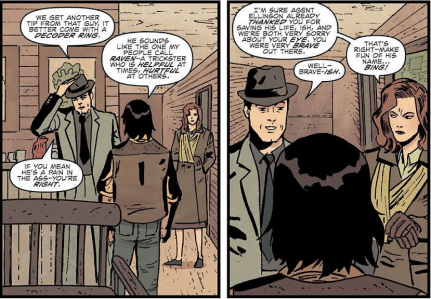
A: Do you think that’s a bad thing? It may not be an “accurate” representation of what people would have been like then – but I’m not sure that I want to read what things would “really” be like.
J: I generally think of it as a bad thing, but I am open to being persuaded. In my opinion, whether in movies, TV shows, or comics, it is easy to visually represent past eras. It is a lot more difficult to create people who actually exist in that era. One of the reasons that Mad Men is a great show is that it succeeds in creating characters who think and live in ways people did in the 1960s and 70s. That is also one of the reasons why a lot of people don’t like Mad Men. The overwhelming misogyny of the male characters is just too much. This is also why I think Downton Abbey or Masters of Sex is such a failure, all it does it place modern people in old-timey clothes.
A: I guess maybe you’re right. The reason I don’t care for Masters of Sex is that I don’t feel like the creators have grappled with the reality of the story they are telling, a reality which, in their case, is not particularly flattering. Virginia Johnson, who is played by Lizzy Caplan, was at the time an unwilling sexual partner and a coerced subordinate of Dr. William Masters (Michael Sheen). Instead of dealing with this reality, the show’s creators have turned Masters and Johnson into these very contemporary, forward thinking characters who would not be particularly out of place in the modern world.
J: Period drama is all the rage right now on TV (Outlander, The Knick, or Boardwalk Empire). I’ve not watched a lot of them. But, from what I have seen most are simply modern day dramas in fancy dress. Basically, set dressing is easy, characterization is hard.
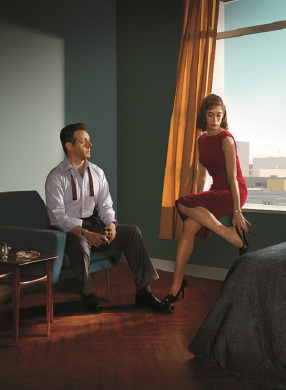
Michael Sheen, Lizzy Caplan in Masters of Sex
A: But, in The X-Files, we’re not really dealing with reality nor are the authors trying to make Mad Men-esque entity. So, why not make it enjoyable, without dealing with the politics of a half century ago?
J: I guess maybe you’re right. We are talking about a story with werewolves, psychic phenomenon, and dog catchers. Plus a villain named Mr. Zero. Or is it Xero?
A: I’m hoping there is some long play with the Zero v. Xero game – because otherwise I find it simply inconsistent and vaguely annoying.
J: I assume the reason for spelling Zero as Xero is that, when the case is solved, it will be filed under X. Hence, the X-Files.
A: Huh. I always assumed the X was from extraterrestrial.
J: Well, this is a place where The X-Files comic universe diverges from the television universe. If I remember correctly, the reason for the X was because so many paranormal cases went unsolved and were filed under U. Eventually they ran out of space under U and started filing them under X.*
A: There are a lot of divergences between the comic and television, though, aren’t there? The entire comic, so far, is vaguely reminiscent of a Season 1 episode called “Shapes” – which is supposed to include a phenomenon documented in the first X-File. That said, there are some pretty striking differences between what we’ve seen unraveling in Year Zero and what happened in that episode.
J: True. And that brings up the continuity issue that must be present when reading comics or watch film adaptations. To what extent do comic universes and cinematic or television universes need to be congruent? The X-Files and Star Trek are two television shows that have lived on in comics but their comic incarnations have seemed very hesitant to introduce new perspectives. They’ve seemed more like the redundant novelizations of the Star Wars movie universe that were popular in the late 80s than actual extensions of the characters and setting.
A: Personally, I think the comic-to-movie transition has been more fruitful, which is demonstrated just about every summer with a big blockbuster. But, in the case of those movies, they haven’t just adapted the comic, but also expanded and revised the comic universe. That said, thus far at least, the movie/TV-to-comic adaptations seem a bit dull, at least in comparison.
J: I agree. The X-Files: Year Zero isn’t great in that it doesn’t give us new understanding or insight about the characters. But it does give us an entertaining space to hang out with our old pals, Mulder and Scully.
*Editor’s note: Jeff has the correct origin of the X in X-Files, in the television show.
fin
Anna and Jeff will return next month to continue their conversation about comics, culture and all things X-Files with the next installment of the 5-part series: The X-Files Year Zero
