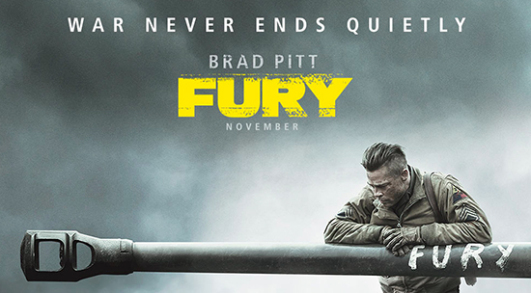
In the opening shot of Brad Pitt’s new movie Fury, an unidentified soldier on a white horse rides out of the sun across a misty dawn landscape of destruction. Then Brad Pitt leaps from a tank and stabs the man in the eye and frees the horse. Here the horse and rider represent the ideal. What the movie wants you to know is: leave your Greatest-Generation ideals behind: this is a depiction of gritty reality.
Or so it would presume.
Writer/director David Ayer told the NY Times recently that he hoped the movie would be true to the “ground truth” of WWII. Whatever that means. I’ve never personally been in a war but I have read The Things They Carried and that must count for something. The thesis of The Things They Carried is this: anything a veteran tells you about a war is a lie. Or in other words: war cannot be represented.
In Fury David Ayer makes a good stab at it. Sort of.
The movie is machined-template war-genre, in which we expect specific characters to die, and others to at least get emotionally wounded. Our man on the ground is one Norman “Machine” Ellison (Logan Lerman), a baby faced new recruit through whose eyes we witness the atrocities of war first hand. The movie lets us know what kind of war-movie it is early on when our man Norman must gather up select pieces of a face left behind on the tank’s bulkhead. His predecessor had his head explode. Norman is disturbed considerably.
As should we be. The trouble is, because the movie hews to the rules of the genre with such exactitude, we know that certain characters must die in a certain series. There are no surprises here: the characters die/survive in an orderly fashion.
Which isn’t to say that this movie is not entertaining. War, in the movies at least, can be fun. Even if it is a long series of clichés. Or especially when it is (one man’s cliché is another man’s tropology). A great amount of this movie’s pleasure comes from just this familiarity: this is the land of Band-of-Brothers, but peopled with bigger stars.
Brad Pitt is dead-on as the wise but war-weary commander Don “Wardaddy” Collier (the proper names in these kinds of movies are irrelevant and stupid: it’s the nick name that’s the clue). He is in top Brad form here, giving a nuanced and emotionally complicated performance. For the course of my movie watching career I’ve been suspicious of Brad Pitt qua Brad Pitt, but not so here, he’s a good enough reason alone to watch the movie. What I realize—confession—is that I love Brad Pitt. He’s just the kind of bro that I’d march into war along side, and maybe that’s half the point of this movie. This is a fraternal and paternal love: Brad is both familiar and admirable. He’s the older brother everyone wishes they had.
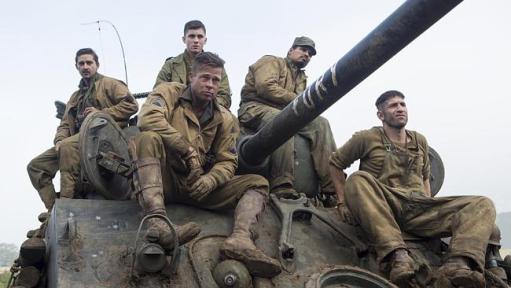
Shia LaBeouf stars in the movie as well and feels about the same as the rest of us about Pitt. Brad Pitt recently praised Mr. LaBeouf as the best actor he’s worked with but I am not in agreement. In Fury Mr. LaBeouf is perpetually shock-faced and crying most of the time. He almost tricks you into thinking he is talented but don’t be fooled, he’s just an actor acting as if he were a great actor. It’s a cunning trick but not successful.
Michael Peña and Jon Bernthal star as jokey assholes to fill out the tank crew. They mean to fill out the human capacity for trauma and brutality as well but it doesn’t quite turn out. The movie wants you to second-guess the moral highground of the WWII GIs, showing you what the war was really like and what it turned our boys into only it can’t pull it off because it doesn’t believe it. At the end of the day, our tank boys’ tough and brutal exteriors are merely hiding hearts of gold and good ol’ American virtue.
“Our ideals are peaceful,” Brad explains, “but history is violent.” The movie is quite violent too. Heads are vaporized, limbs are ripped apart, eyes are shot out, gore splashed, Nazis are indiscriminately shot down by the thousands. All clear signs no doubt of the brutality and “ground truth” of war. But signs too of a more insidious truth: entertainment supersedes gritty reality, and war only exists to be watched later on at the cineplex. Brad Pitt’s other WWII movie, Inglourious Basterds, was well aware of this troubling fact and as a result is a far more unsettling movie than Fury.
That movie asked what Fury ignores: are our ideals really that peaceful?
Forest is a carpenter/writer living in Minneapolis. He writes a weekly horoscope for Revolver. Those can be found here. Follow him on Twitter @interrogativs

best movie very awsome