The macguffin is typically described as that object which the characters in a narrative care a great deal about but the audience does not. Hitchcock, alleged coiner of the term (from his screenwriter), was fairly adamant that the macguffin means nothing. The macguffin has no value beyond its immediate use value as plot-motivator. He cites the classic spy movie/novel as common example. The object of the search for your modest spy is the secret document, mere information, that if the audience were to know would prove meaningless. The papers pursued in North by Northwest and the aeroplane plans in The 39 Steps are as such. One only has to read a few John le Carre novels to send the point home—the reader is very often left in the dark as to the motives of key characters, and at times it seems that there is a great deal of fuss and murder over nothing much at all.
I think this is very much the point of le Carre and presents a mood indicative of the cold war era in general. Seemingly meaningless information being crucial to avoiding world war and nuclear holocaust is more to the point. The iron curtain is in reality weightless and gauzy. That the macguffin is meaningless is exactly what Le Carre’s macguffin means—its meaninglessness is absurd. This is the same figment of bureaucracy that brings about K’s execution at the end of Kafka’s The Trial. It’s a very modern absurdity.
Which is to say that Hitchcock is not always right. The macguffin, often enough, is not just nothing.
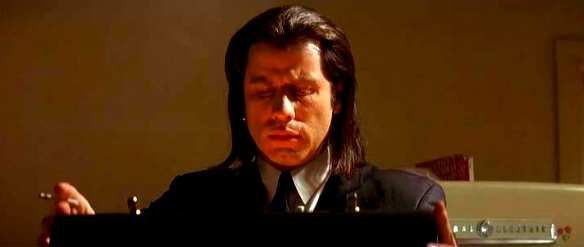
This year marks the twentieth anniversary of the movie Pulp Fiction. This is a movie that continues to astound. It has been rightfully sainted among the great movies. This movie is going to heaven. One reason to account for this sanctity, I would argue, is its macguffin: the infamous briefcase. The contents of this briefcase are never revealed. It was planned to be filled with diamonds but Mr. Tarantino at the last minute chose otherwise. John Travolta opens the case (combination 666) to release a golden light which shines on his face wide eyed in amazement. The same when Tim Roth opens the case. “Is that what I think it is,” he asks.
“Yes”, says a cool Samuel L. Jackson.
“Goddammit, what is it?” Amanda Plummer asks.
“It’s beautiful.”
As far as what it is, we the audience are not told and can only guess.
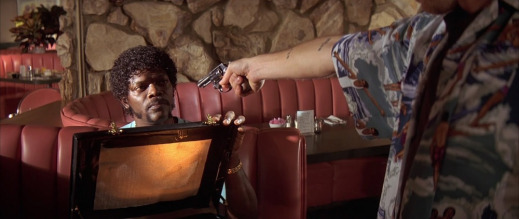
Upon initial viewings the shining case was a curiosity and amusing: Tarantino screwing with the template—diamonds would be typical, sufficient and boring. After twenty years and multiple viewings, however, the mystery of the briefcase takes on a charged significance.
Tarantino has claimed that the briefcase is a classic macguffin and thus, meaningless. Don’t believe it.
It’s precursor is the nuclear suitcase in Kiss Me Deadly. This one too shines when opened, but it shines with the light of radioactivity and atomic destruction.
Google interpretations of the Pulp Fiction briefcase and you’ll find plenty. The most common being that it contains Ving Rhames Soul (which has been stolen by the devil). Another plausible argument is that its contents are some quantity of grace (the antithesis of the nuclear destruction) and that once opened it is allowed to influence for the better the logic of the movie: “God got involved,” Samuel Jackson says. Both he and John Travolta are “miraculously” saved from gunfire that shouldn’t have missed. Uma Thurman is saved from her overdose. Bruce Willis saves Ving Rhames who in return forgives Bruce Willis. Tim Roth and Amanda Plummer both receive grace in the end from Sam Jackson, the avenging angel.
These interpretations are fine and good but I would make the argument that what the case really contains is just that amount of emptiness required for critical discourse. That is, the briefcase is like the Holy Grail: it gets filled up with whatever history/the viewer deems fitting.
Which is to say that it asks more questions than it answers. That kind of emptiness, this questionable content, is something, that once realized, influences the rest of the movie with a swarm of interrogatives. Such as:
-Why are there six bullet holes in the wall behind Samuel Jackson and John Travolta when only five shots have been fired?
-Also, why are those bullet holes seen in the wall in the shot just before they were fired from the gun?
-Why is Quentin Tarantino starring in this movie?
-Why does Ving Rhames have a band-aid on the back of his neck? It is a white-skin-tone-colored band-aid: is there such a thing as a black-skin-tone-colored band-aid? If not, why not?
-What is the significance of John Travolta seen reading the same book (“Modesty Blaise” a French spy novel) on the toilet, twice?
These are questions, among others, which once pursued, allow for latent figurations: that is, the movie begins to mean in ways that could not be wholly understood by initial viewers, nor even by its creators. The film takes on what literary theorist Frank Kermode refers to as the spiritual sense—as opposed to the literal—in that there is more going on than meets the eye. So the abundance of interpretations.
Not that interpretations add anything of value but it is my view that the mere possibility of this spiritual sense is in itself a kind of formal elegance and raises the film to the status of art. It is the elegance of the posed question. For film achieves art, not by what it means, but by how it means.
As Eli Wiesel has it, “Every question possesses a power that is lost in the answer.”
This is the same radioactive power that the briefcase contains.
*a version of this article originally appeared at Hothouse Magazine
Forest is a carpenter/writer living in Minneapolis. He writes a weekly horoscope for Revolver. Those can be found here. Follow him on Twitter @interrogativs
Follow The Stake on Twitter and Facebook
