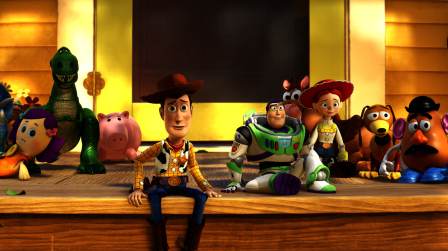
Last week Pixar Studios announced their plan to make Toy Story 4. The news is unfortunate.
Pixar Studios released its first film, Toy Story, twenty years ago. Since then Pixar has had a run of such impressive quality that they rival any studio in the period. They’ve made not just well-regarded films, but creative films, weird and unexpected movies. Pixar became a place known for making original, never-before even seen works of art.
It would be premature to say this phase of creativity has ended at Pixar. No studio or director, Pixar included, can continue outrageous string of films like Ratatouille, WALL-E, Up, Toy Story 3. To expect any studio, let alone one owned by Disney (they bought Pixar in 2006), to operate at such a level indefinitely is unfair (Studio Ghibli is the only other one that comes to mind with such a string of great films).
But this era does appear to be over. Since Toy Story 3, Pixar made the studio’s weakest film in Cars 2, their weakest of the very strange original concepts (though still quite good) in Brave, and another perfectly adequate sequel, Monsters University.
So what’s the problem with Toy Story 4? Why is news of another entry in one of Hollywood’s best trilogies in decades (that’s right) something to lament rather than celebrate?
Because #4 is, generally speaking, a bad idea.
Stories love trilogies. Writers love trilogies. The three part nature of stories has been working since Aristotle and it’s no wonder that the rise and fall of the three-part series has provided the world its greatest achievements in movie series. The trilogy gave us Star Wars. It gave us Indiana Jones. It gave us Lord of the Rings. It gave us Bourne.
It gave us countless film series that, like each of these, is worse because #4 was made.
Discerning minds know, #4 is a bad idea. It’s time for Disney and Hollywood to explore new worlds and new civilizations (Star Trek 4 is pretty good, but Star Trek was never a Trilogy) rather than return to properties that are almost perfectly conceived and executed. Whatever inspires these returns, the effect often ends up having a retroactive negative impact, and comes off as a plan to make more money by exploiting audiences love for characters whose stories are truly complete.
The Toy Story series is wonderful. It is funny and poignant and and surprising. It is also complete. When Toy Story came out in 1995 it was original. The first of its kind in digital production, but more than that, it felt fresh and alive at a time when family movies were defined by Robin Williams or declining Disney Animated features.
That life and vibrance expanded as Andy’s toys faced their perilous journey to Al’s Toy Barn in Toy Story 2. Rather than death or division, Andy’s toys built new relationships, and grew. Then, in Toy Story 3, like all great conclusions, the end comes. The emotional resonance that comes with the end of Toy Story 3 was the final surprise of the series. It was beautiful and moving, and reached a satisfaction that our best film-makers hope to achieve.
It’s hard to imagine how making Toy Story 4 could possibly make this story better.
Pixar is not immune to the tendency towards franchise overkill. They seem to be spending less time in the creative mill that defined their studio in years past and more time in existing territory.
Along with Toy Story 4, Pixar’s upcoming features include Finding Dory, Incredibles 2, and Cars 3. Next year’s Inside Out sounds truly bonkers, and I greatly hope that it is because Pixar’s unique voice in the expanding Disney-ification of the entertainment world is more necessary than ever.
