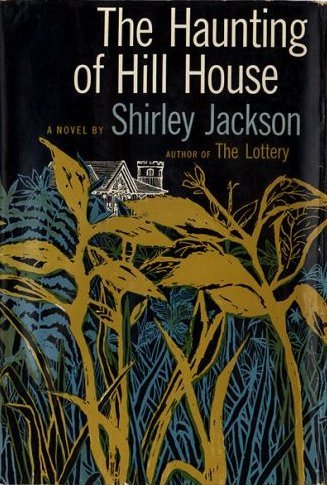
 When I read classic genre novels, I’m often surprised by how subdued they are, how stingy, by today’s standards, with their entertainments. Shirley Jackson’s The Haunting of Hill House is a ghost story, as compulsively readable—and as scary—as they come. Yet for a time the novel reads like a story by Sherwood Anderson, Flannery O’Connor, or Katherine Anne Porter. It’s a horror book that makes you work for its scares; but the dedicated reader is rewarded with a sense of unease that goes beyond simple fright, and that won’t be soon forgotten.
The setup is that of a pure haunted house story: two women named Eleanor and Theodora are invited by Dr. Montague, a researcher of the paranormal, to visit the mysterious Hill House, rumored to be haunted. They’re joined by the heir to the estate, Luke Summerson, and together the foursome resolve to live in the house until they can solve its mysteries. The opening paragraph is among the eeriest bits of scene-setting in the history of the English language (read it aloud, if you can):
No live organism can continue for long to exist sanely under conditions of absolute reality; even larks and katydids are supposed, by some, to dream. Hill House, not sane, stood by itself against its hills, holding darkness within; it had stood so for eighty years and might stand for eighty more. Within, walls continued upright, bricks met neatly, floors were firm, and doors were sensibly shut; silence lay steadily against the wood and stone of Hill House, and whatever walked there, walked alone.
Yet, in spite of this creepy beginning and a classic horror premise, the novel defies the conventional expectations of the genre. It’s dozens of pages before we even reach the house, and the book resembles, at first, a deep character study or novel of manners. The story centers on the character of Eleanor Vance, a sad, friendless woman who at the beginning of the story has just come to the end of eleven years caring for her ailing mother. Jackson tells us that “her years with her mother had been built up devotedly around small guilts and small reproaches, constant weariness, and unending despair”; it’s strongly implied that Eleanor killed her mother, or at least allowed her to die. Now, Eleanor lives with her sister and brother-in-law, sleeping on a cot in the baby’s room, her life a progression of small humiliations. She has to beg for permission to even use the car.
These details contain their own kind of domestic horror—there’s more than a little of Eleanor Vance and her fraught family relationships in Stephen King’s Carrie or Ira Levin’s Rosemary’s Baby. Horror is rooted in the everyday; it’s scary because it feels real. Eleanor is more than a little scary herself: we’re frightened of her because she’s a little off, and we’re frightened for her because she’s so delicate, so unequal to the world that’s waiting for her outside her front door. She seems to view the trip to Hill House as a sort of vacation, the start of her new life without her mother. On the car trip to the house, she can’t keep herself from dreaming of liberation; in the car she stole from her sister, she savors the freedom of the road and gazes with wonder at each new stop on her journey, imagining what her life might be like if she lived in this place, or that. Eleanor’s journey evokes the American ideal of rugged individualism—with each mile closer to Hill House, she comes closer to leaving the past behind, to making herself new.
Yet what waits for Eleanor Vance in Hill House is not a remaking, but an undoing. Everything Eleanor encounters in the house reflects the neuroses she’s brought along with her, from the haunting itself to her fellow occupants: Theodora, Luke, and Dr. Montague. Together, the foursome constitute a sort of temporary family—yet this family is no less dysfunctional than the one Eleanor left behind. With Theodora, Eleanor enters an intense sisterly relationship that swings wildly from love to hate and back again; Luke she seems to view as somewhere between a brother and a lover; and Dr. Montague is a friendly but ineffectual father. When Montague’s overbearing wife comes to join the proceedings—evoking memories of Eleanor’s cruel mother, perhaps?—things in the house take a turn for the worse, and the ghosts that haunt Hill House begin to focus their terrifying energy on Eleanor herself.
It’s not entirely clear whether Eleanor is a victim of the house or the thing that haunts it—the house, says Dr. Montague, was “born bad,” yet at times it seems to be simply reflecting Eleanor’s own ghosts, her inner demons, back at her. The narration focuses so claustrophobically on Eleanor’s perspective that it’s hard to tell whether what she perceives is really happening or whether she’s just projecting her psychic wounds into the space around her. And perhaps it doesn’t matter. It’s that very uncertainty that is ultimately what’s so upsetting about this novel. The claustrophobia that pervades the book’s descriptions of the house are reflective of Eleanor’s own claustrophobia in relation to the fraught issues of family and domestic spaces.
The book ends with the same words that were used to open the story, the same description of Hill House. Except that now, it’s not clear whether Jackson is referring to the house, or—obliquely, symbolically—to Eleanor. Not sane. Holding darkness within. Alone.
Follow The Stake on Twitter and Facebook
