There was a lot going on in last night’s episode, but what’s standing out to me this morning is three small moments, each featuring the remaining Stark kids making a decision about who they were going to be.
The first one features Jon Snow, not technically a full-fledged Stark kid, I know, and there are all sorts of theories about his parentage besides, but still. He’d rejected Stannis Baratheon’s offer to help him retake the North again, and now it was his time to assert himself instead in the role he’d chosen: Lord Commander of the Night’s Watch. With the choice of humiliating or honoring his rival Allister Thorne, he took the high road and gave him the role of First Ranger rather than latrine-digging duty, a smart move. Then came the harder task: giving Allister’s buddy Ser Coward a task he didn’t want to do. When the man refused, Jon instructed the men to take him outside; they obeyed, and Allister didn’t get in the way.
That’s when Jon’s moment came. Everyone was outside, and he was the last one still sitting in the dining hall, taking a last drink and making a decision about what he was going to do and who he was going to be. Could he do this? Did he have it in him to be this strong? Just a moment—then he walked outside and sliced the guy’s head off, just like Ned Stark did to a member of the Night’s Watch in the very first episode.
Ned Stark’s many seasons dead, but his ghost was haunting the Stark kids last night. As Jon was trying to walk in his father’s footsteps in the North, Sansa was having her own negotiation with daddy’s memory near Moat Cailin, the stronghold of Roose and Ramsay Bolton. Littlefinger’s plan for Sansa has become clear, and it’s the biggest gut-punch of the episode: he’s planning to marry her off to psychotic, sadistic Ramsay in order to solidify an alliance between himself and the Boltons. He’s got the Eyrie, and now he’s got the allegiance of the most brutal family in the North; Littlefinger’s no dummy. But Sansa’s a pawn in his plan, and before he can make it work he’s got to convince her to go along with it. “I won’t force you to do anything,” he says (I’m dubious). “But you’ve been a bystander to tragedy since the day they killed your father. Stop being a bystander, stop running. There’s no justice in the world unless we make it. You loved your family, now avenge them.”
It’s a convincing speech. Sansa takes a moment, looking toward the castle, and when she turns around she’s a changed person, again—she’s resolved to do this, even if it means marrying into the family who killed her mother and brother. I can’t quite see the endgame here: what’s she supposed to do, ride out a marriage to a crazy person until they’ve killed the rest of the Lannisters, then kill Roose and Ramsay in their sleep? But as Jon says, keep you enemies close. (And as Stannis responds, “Whoever said that didn’t have many enemies,” something Sansa would do well to remember when dealing with Ramsay and his sadistic girlfriend.)
Across the Narrow Sea, Arya’s playing a different kind of long game. Let into the House of Black and White last week, she’s now discovered that inside it’s a weird Beckett play all the time. She’s assigned to sweep a room endlessly, as people die from drinking the water and silent hooded figures cart corpses one way and another. When people talk to her, it’s with cryptic demands that “all men must serve,” or to ask her who she is—when she replies, as she thinks she should, with “no one,” she gets beaten.
Apparently Arya can’t truly become no one until she gives up all her stuff—but she can’t, not quite. The one thing she can’t give up is her sword, the thing that ties her to Syrio Forel, to Jon, to her father. So she hides it instead. It’s a delicious moment of (in)decision that economically dramatizes Arya’s predicament. What does becoming no one really mean? Sure, she has to give up her name and all her stuff, but does she have to give up her plan for vengeance as well? Does she have to give up her list of names, the thing that brought her to the House in the first place?
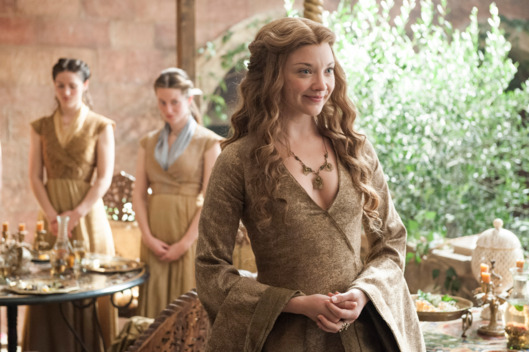
Let’s see, what else do we have going on? Well, in King’s Landing, Margaery and Tommen are getting married and enjoy a fun wedding night and—wait a second, just how young is Tommen, anyway? Book readers will remind us that in the novels, Danaerys was married off at thirteen or something crazy like that, so it’s not the first time GoT has married off a youngster. Still, this episode gets a lot of mileage by contrasting Margaery’s voluptuousness with Tommen’s gawky boyishness. After sex, Margaery slyly plants some ideas in her husband’s head about Cersei: she’ll always be your mother, you’ll always be her little boy. She’s a sly one, and Tommen responds by trying (and failing, for the moment) to send Cersei away, back to Casterly Rock.
Last night also gave us a better look at the religious sect we met in the season premiere: the Sparrows. They come on the scene to shame the High Septon for his hypocrisy in visiting a brothel (obligatory scene of female nudity! everybody drinks!), parading him naked through the streets and hitting him with sticks every time he tries to cover the…ah, “little septon,” shall we say. The Septon’s complaint to the ruling council leads Cersei to the High Sparrow, an aescetic played by Jonathan Pryce. The episode is named “The High Sparrow” for his title, but this is one of the least compelling parts of the episode. It’s an undeveloped thread, something that appears it might pay off next week, when Cersei plays the Sparrows’ desire for dominance over the seven-gods’ religion into a political play in King’s Landing. We’ll see next week how this develops.
Odds and ends:
• Podrick and Brienne had a nice scene last night in which each shared a story from their past. Podrick shared the tale of how Tywin Lannister saved him from execution for theft, a story that explains his devotion to the knights he squires. Brienne went quid pro quo in telling the tale of how Renly Baratheon was the only boy at a ball to dance with her. “Yes, Pod, he liked men, I’m not an idiot, but he was kind. He saved me from being a joke that day until his last day.”
• Hey, remember the Mountain? The guy who killed Oberyn last season, but not before Oberyn managed to poison him? Well, he’s still alive under a blanket in Cersei’s mad scientist’s laboratory, and seeing that sheet move as the guy killed rats under a magnifying glass was legit terrifying. The show’s just reminding us that he’s there—and I expect a damn good payoff when he reenters the story.
• The one character I didn’t touch on above was Tyrion. Compared to everyone else, he still hasn’t got much going on, but his storyline did provide a few points of interest. Most fascinating to me was that Melisandre’s religion of one god had adherents across the Narrow Sea, and more red priestesses, besides. I thought Melisandre was the only one. Even more fascinating is the revelation that Danaerys is somehow becoming associated with the religion in Essos, as a sort of savior figure, while back in Westeros it’s being used to support Stannis. Which just goes to prove that wherever you go, religion can be used for political ends. (Oh, and Tyrion also gets kidnapped by Jorah Mormont. Cliffhanger!)

Just when Sana escapes marriage to a psycho she’s thrust into another deal with a lunatic, all as a man’s pawn. I admire her resolve, and hope she can take care of herself in her old home. The old woman remembering her as a Stark was promising-maybe she can forge some alliances.
Littlefinger’s really just the worst. I’m worried about Sansa, and furious at him for using her like that.