 Joss Whedon’s Avengers was released on May 4, 2012. Avengers: Age of Ultron will be released May 1, 2015. In the interim, these films hit theaters: The Amazing Spider-Man, The Dark Knight Rises, Dredd, Iron Man 3, Man of Steel, The Wolverine, Kick Ass 2, Thor: The Dark World, Captain America: Winter Soldier, The Amazing Spider-Man 2, X-Men: Days of Future Past, Teenage Mutant Ninja Turtles, and Guardians of the Galaxy. That is 13 films all qualifying as superhero-action movies based on comic books squished between the tent-pole that holds up the tent-poles of the Marvel Cinematic Universe.
This is the cinematic landscape of our time, built on the disposable income of teenagers. Avengers: Age of Ultron is just another superhero movie, which is a problem worthy of countless think-pieces on Hollywood’s business of content creation. But we all know it’s not changing anytime soon. Given this movie landscape, we should count ourselves lucky to get Age of Ultron.
Which is to say, Ultron is pretty damned cool. It’s fun, well-made, and engaging; it has high energy performances, a few surprises, and a number of quite funny jokes. It’s true that: it has too many characters, wastes too much time meeting the requirements of Marvel Grand Design, and lumbers through a few unnecessary subplots. These realities keep Ultron from reaching the heights of the best superhero cinema.
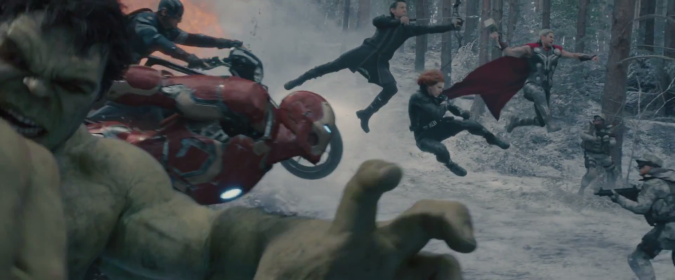
But this movie succeeds anyway mostly as a result of the skill and the sheer willpower of its participants. Whedon and his cast put so much effort forth that its easy to be seduced by the proficiency of action on display. This is evident from the opening moments-a tracking shot through a snowy forest which finds the Avengers mid-action scene-and it’s clear that this level of effort never for lets up.
This time around, Whedon starts his story in the middle. The Avengers are in search of Loki’s scepter, which is being held by a madman and his two “enhanced” agents (mutants, a word Marvel sold to 20th Century Fox), the Maximoff Twins, Wanda and Pietro (aka Scarlet Witch and Quicksilver).
The Maximoff twins blame Tony Stark for the death of their family (his name was right there on the shells), and they’re looking for revenge. After the Avengers find the scepter, they also find a plan to use it to create artificial intelligence. Stark seeks A.I. as a possible way out for all of the Avengers. To build a protective defense for earth that requires no human defenders. This, of course, goes horribly wrong, and the bi-product is Ultron, a sentient program that can inhabit tech, robots, or just live on the web. Stark wanted to create peace on earth; Ultron sees humanity as the earth’s greatest threat, a threat embodied in the Avengers; ergo, peace on earth comes through killing the Avengers. It’s comics logic, but it works when you hear it delivered in speeches by James Spader (who voices Ultron).
That’s the set up. There’s less backstory in Ultron than almost any other Marvel film, and what is provided is more pointed and human. Whedon also seems to have heard critics of The Avengers, and the superhero genre in general, and takes pains to find turns to avoid leaving audiences with that feeling of ‘I saw that coming.’
The interesting thing about Age of Ultron is that, in many ways, it’s a better film than the original. For one, Age of Ultron is better directed than its predecessor. In 2012, Whedon relied almost entirely on his writing skills and character interaction. What was left over went into the final action scene. That left some fairly bland film-making in between. That problem is largely overcome in Ultron. The action scenes here are crisp and the visual representation of that action is clear (such a rare treat, to see what’s happening in complicated action scenes). The pacing and structure is better organized (perhaps as a result of avoiding the introduction of each character individually). Ultron still funny, but has a more sophisticated cinematic feel, something Whedon has never achieved.
This is not the muddled mess of Transformers. It’s a science-fiction movie about A.I. starring some existing, if over-exposed, characters played by professionals-how terrifically lucky that such professionals took these jobs; Ruffalo and Johannson and Evans and RDJ make up so much of why these films succeed. Watching Age of Ultron, it is evident how much better Whedon is at spending $200M than he was in 2012. This is, remember, only the fourth time Whedon has directed a film. He’s getting better at that task.
Still, the limitations on this film are great, and they are hard to overcome. Marvel needs to transition to Phase 3 and Captain America: Civil War, and that task requires certain story beats, certain character conflicts, and certain conclusions. Regardless of who is “responsible” for them, this is the stuff that makes Age of Ultron the cultural monster that it will surely be this summer. But the Marvel Cinematic Universe is also a unique multi-film franchise project, one whose success is both massive, and earned on the creative combination of studios and artists. This combination isn’t new, but it hasn’t succeeded this well since the golden age of Hollywood Musicals.
Expectations on this film are high, and rightly so. Avengers is the third most successful film of all time. It wowed critics, riled up the fans, and opened up a new demographic to the Marvel Universe. Age of Ultron will do none of those things. If that is the bar, then this movie will disappoint.
But is that really the bar? If so, how many times can it ever be lifted?
I’m a fan of this genre, and of Joss Whedon. Whedon really wants audiences to enjoy this film, not because of but in spite of the predetermined building blocks he has been given. He knows audiences are constantly exposed to this stuff, and that we tire of it. From the sound of it, he’s pretty tired of it too. He’s left his mark, indelibly, on one of the unique creations of modern movies. So, if nothing else, fans of science-fiction and genre film should celebrate Avengers: Age of Ultron for releasing Joss Whedon back into the wild.
